




Apolo Blogs
Cryptocurrencies and Ecuador’s Bankruptcy Law: What Has Changed and What Is Significant for Companies?
Cryptocurrencies and digital assets have gained increasing prominence in the business environment in recent years. Although their adoption as a means of payment remains a regulatory issue in Ecuador, more and more organizations are analyzing the role these assets can play within their financial and asset-management strategies.
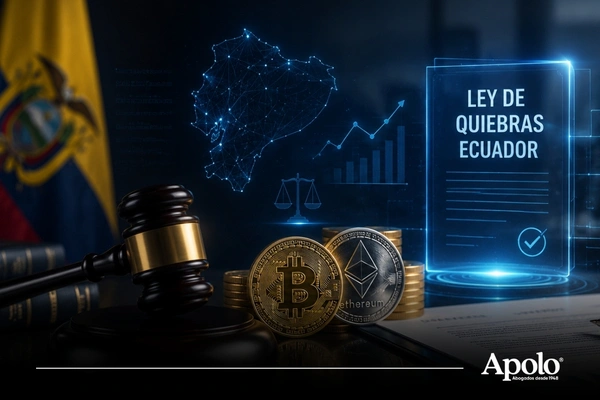
In this context, the Business Restructuring Decree-Law, known as Ecuador’s “Bankruptcy Law,” sparked significant debate by incorporating references to digital assets within corporate reorganization and liquidation proceedings.
What Did the Decree-Law Propose?
The initiative, presented by the Executive Branch on July 7, 2023, aimed to provide more flexible mechanisms for companies experiencing liquidity problems but that remained solvent, allowing them to restructure their obligations and avoid liquidation.
One of the most notable aspects of the proposal was its treatment of digital assets, including those represented through blockchain technology, which would have been considered intangible assets within insolvency proceedings.
The Debate Over Cryptocurrencies
The inclusion of these assets raised concerns among various authorities, particularly the Superintendency of Banks, which expressed concern about a possible interpretation that could facilitate the recognition of cryptocurrencies as an official means of payment.
However, it is important to distinguish between two completely different concepts:
- Recognizing a digital asset as part of a company’s assets.
- Recognizing a cryptocurrency as legal tender.
From a legal perspective, these are two different scenarios, with different implications and governed by separate regulatory frameworks.
What Does Ecuadorian Legislation Currently Provide?
The reform to the Organic Monetary and Financial Code establishes that the only entity authorized to issue currency in the country is the Central Bank of Ecuador and that the United States dollar remains the only legal tender.
This means that, although a company may hold digital assets as part of its assets, this does not automatically grant cryptocurrencies the status of an official means of payment within Ecuador’s financial system.
Beyond the Legal Aspect: A Challenge for Digital Transformation
The growth of digital assets demonstrates that organizations will need to adapt to an environment in which financial information, digital records, and emerging technologies will become increasingly relevant.
Blockchain, smart contracts, tokenized assets, and cryptocurrencies are part of a digital transformation that requires more transparent processes, appropriate information management, and a strategic approach to the risks and opportunities associated with these technologies.
Key Considerations for Companies
In light of this evolving landscape, organizations should consider:
- Assessing the regulatory impact of digital assets on their operations.
- Implementing management and control policies for technology-based assets.
- Strengthening the traceability and security of financial information.
- Maintaining compliance processes aligned with applicable regulations.
- Incorporating digital tools that facilitate data-driven decision-making.